World War 1 (1914-1918) ended with around 40 million dead. It was hoped that the violence, death and destruction wreaked by that war would bring people to their senses. But only a year after the war, George Bernard Shaw, in a letter to Judge Henry Neil, wrote ominously: “The longer I live, the more convinced I am that this planet is used by other planets as a lunatic asylum”.
Far from being: “A war to end all wars”, World War I paved the way for the much more terrible World War 2 as the victors immediately set about humiliating the vanquished, fomenting in them a thirst for revenge. In World War 2 (1939-1945) 80 million died as a direct result of the conflict, 55 million of them civilians, another 25 million died of war related causes. Of these millions were killed in acts of genocide and as victims of atomic weapons. Cities, economies and infrastructures were totally destroyed.
Out of this massive human tragedy was born the United Nations , whose Charter declared it was “determined to save succeeding generations from the scourge of war, which twice in our lifetime has brought untold sorrow to mankind, and to reaffirm faith in fundamental human rights, in the dignity and worth of the human person, in the equal rights of men and women and of nations large and small, and to establish conditions under which justice and respect for the obligations arising from treaties and other sources of international law can be maintained, and to promote social progress and better standards of life in larger freedom.”
The leaders of people from different cultures, political systems and continents came together, pledging “to practice tolerance and live together in peace with one another as good neighbours, and to unite our strength to maintain international peace and security, and
to ensure, by the acceptance of principles and the institution of methods, that armed force shall not be used, save in the common interest, and to employ international machinery for the promotion of the economic and social advancement of all peoples.
Since that Charter was born 80 years ago tens of millions have been killed, including through acts of genocide, in at least 100 wars and conflicts raging in Asia, Europe and Africa.
Less known is that millions more have died as a result of economic sanctions. A study of mortality rates and sanctions carried out by the Center for Economic and Policy Research and published in The Lancet Global Health, last August, shows that sanctions by the United States and the European Union have contributed to 38 million deaths between 1971 and 2021. These lethal economic sanctions are framed as a humanitarian alternative to war — a way to pressure “rogue states” or “terrorist regimes” to change their behaviour without resorting to armed conflict. When US Secretary of State Madeleine Albright was asked to comment on the fact that sanctions against Iraq had killed half a million children, she said “the price we think, is worth it.”
Bound by the same rope
The United Nations is often blamed for being impotent in the face of war and domination. The United Nations depends on its member states for its effectiveness and how these use their power or fail to use it and abuse it. While its structures need to be updated to reflect a changed world, its core values are still valid and can save us from our killer nature.
The world together spends more than €2 trillion on war and weapons, 600 times the regular budget of the United Nations.
Global governance is degenerating fast into a game with no rules, worse than the traditional Afghan game (Buzkashi). The latter is a very brutal, chaotic and intense “war of all against all’ using the carcass of a decapitated goat. There are powerful people in the world today who want to conduct politics using the carcass of international law, the UN Charter and conventions emerging from the painful lessons learned in World War 2.
Once upon a time, those who were ready to speak truth to power called these emperors with no clothes as they paraded solemnly, disguised in the robes of democracy and human rights. Today the emperors have themselves ripped off their clothes, don’t even pretend to live by the ideals of democracy and human rights, but flaunt their naked power without shame.
Political leaders who used to stress how interdependent the world had become and advocated open trade and globalisation now call increasingly for trade to be conducted within a much more narrowly defined basket of “friends” who share common “values”. But is it realistic to expect that a small basket of friends can provide the necessary resources, supply chains, know-how, manufacturing processes and markets to allow leaders to cut themselves off from the rest of the world made up of “enemies”?
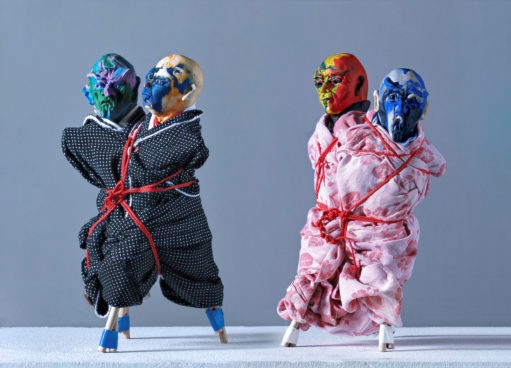
Thomas Schütte’s sculptures ‘United Enemies’ are an excellent metaphor for the human condition. Two men who hate each other cannot escape from one another. They are tied by the same rope. Unable to stand alone they help each other remain upright on their unstable stilts. They can use their rope for coexistence or for mutually assured destruction.
Our world has become so small that we are all bound inextricably to each other. We need to find ways of living together, if not as friends at least as enemies. Whether we like it or not we are bound to each other, as strangers, as neighbours, as enemies.
If we want to slow down global warming to be able to survive on our planet, if we want to contain global pandemics, if we want to harness AI for human development and well-being, if we want to save humanity from a nuclear apocalypse, if we want to use our resources to provide a decent life where every person can live free from want and fear on this planet, we must find ways of living together even if we hate each other.
Times 07 November 2025