In November 1839, John O’Sullivan was writing in ‘The United States Democratic Review’ that the US had the divine mandate to expand its territory across the North American continent from the Atlantic to the Pacific Ocean: “We are the nation of human progress, and who will, what can, set limits to our onward march? Providence is with us, and no earthly power can.”
In ‘Annexation’ in 1845 John O’Sullivan announced that America’s ‘Manifest Destiny’ is unstoppable. “The American millions destined to gather beneath the flutter of the stripes and stars” will defeat those who oppose them even if they are armed with “all the bayonets and cannon, not only of France and England, but of Europe entire…”
In this expansion, Native Americans lost up to 98% of their ancestral homelands. The US government waged over 1,500 wars, attacks and raids on Native Americans to remove them from their lands. A government report from the 1890s estimates that around
30,000 Indigenous people were killed in military conflicts alone between 1776 and 1890. Other estimates for massacres and starvation range from 40,000 to over 200,000. As their lands were taken over violently, the Native Americans lost their food sources, such as hunting for bison, and were left without food, even if this was promised.
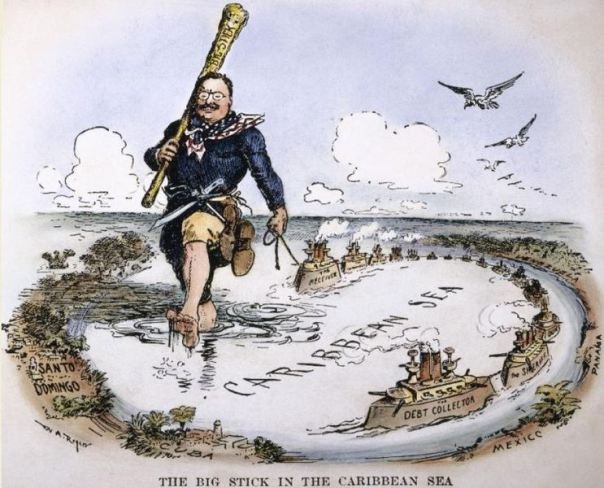
This forced displacement was a central component of westward expansion mainly achieved through the ‘Indian Removal Act of 1830’ of President Andrew Jackson (1829-1837). An admirer and follower of Jackson, James Polk (1845-1849) doubled the size of the United States, annexing California after a war with Mexico and negotiating a treaty with Britain to annex Oregon.
When last year Donald Trump returned to the White House he hung the pohotos of his two favourite presidents – Andrew Jackson and James Polk – in the Oval Office. Trumps admires Jackson for his confrontational attitude and hyper-presidentialism, bypassing constitutional checks and balances. In ‘The Painting That Explains Trump’s Foreign Policy’, The Wall Street Journal (13 March 2025) wrote: “James K. Polk expanded the U.S. more than any other president. Now his portrait hangs in the Oval Office, a signal that President Trump’s ambition to take over Canada, Greenland and other territory is more than just talk.”
Introducing the ‘US National Security Strategy’, President Trump declared: “In everything we do we are putting America first.” This document recognizes that every country must put its national interests first: “Primacy of Nations – The world’s fundamental political unit is and will remain the nation-state. It is natural and just that all nations put their interests first and guard their sovereignty. The world works best when nations prioritize their interests. The United States will put our own interests first and, in our relations with other nations, encourage them to prioritize their own interests as well.”
“No international niceties”
The document states: “In the Declaration of Independence, America’s founders laid down a clear preference for non interventionism in the affairs of other nations and made clear the basis: just as all human beings possess God-given equal natural rights, all nations are entitled by “the laws of nature and nature’s God” to a “separate and equal station” with respect to one another.”
But then what happens when the national interests of the United States collide with those of other countries? Do those of the United States prevail automatically or is there a serious effort to look for mutual benefit through negotiation and dialogue? Learning from the tragedies of two world wars, the United Nations Charter in Article 2 states that countries: “shall settle their international disputes by peaceful means in such a manner that international peace and security, and justice, are not endangered.” And that states “shall refrain in their international relations from the threat or use of force against the territorial integrity or political independence of any state, or in any other manner inconsistent with the Purposes of the United Nations.”
The US National Security Strategy leaves us in no doubt that US unilateralism should prevail over multilateralism: “We stand for the sovereign rights of nations, against the sovereignty-sapping incursions of the most intrusive transnational organizations, and for reforming those institutions so that they assist rather than hinder individual sovereignty and further American interests.”
In fact, in the first days of 2026, President Trump signed a memorandum directing the U.S. to withdraw from 66 international organizations, including entities affiliated with the United Nations, saying the programs no longer serve U.S. interests. He now has a ‘Board of Peace’ as an alternative to the UN, where decisions are taken only if he approves them. He has used NATO to decide about Denmark and Greenland without even consulting them.
Stephen Miller ideologue-in-chief of US President Donald Trump told CNN: “We live in a world in which you can talk all you want about international niceties and everything else. But we live in a world, in the real world … that is governed by strength, that is governed by force, that is governed by power. These are the iron laws of the world.”
Trump told ‘The New York Times’ that he does not “need international law” and asked whether there are any limits to his global powers, he answered: “Yeah, there is one thing. My own morality. My own mind. It’s the only thing that can stop me.”
In a post he states that he is the acting president of Venezuela, after the kidnapping and abduction of its head of state. Territory and resources of Greenland are to be possessed by the US without any consideration to the sovereignty of Denmark and much less of Greenland.
The EU has put all its security and energy eggs in one basket of the US. It chose NATO and war over OCSE and cooperative security in Europe, making it totally subordinate to the US. The EU has yet to learn strategic autonomy, that nations have “no friends, only interests” (Charles De Gaulle) and to start building good working relationships with as many countries as possible in today’s multipolar world.
Times of Malta 30 January 2026